
The short answer: Feeling sad, anxious, or empty during the holidays isn’t a personal failing—it’s a predictable response to unrealistic cultural expectations, grief triggers, neurochemical patterns, and genuine exhaustion. The gap between how society says you should feel and how you actually feel is one of the most isolating aspects of this season.
The cultural script is powerful and pervasive: twinkling lights, joyful music, and heartwarming images of families gathered in perfect harmony. From late autumn onward, we are surrounded by a story that insists this is the “most wonderful time of the year.” But for many of us, the private, internal reality feels jarringly different. Instead of joy, we might feel a profound sense of emptiness, a spike in anxiety, or a heavy, lingering sadness that settles in just as the festivities reach their peak.
This feeling—sometimes called the “post-Christmas blues” or the “holiday hangover”—is a deeply common but rarely discussed experience. It’s the quiet letdown after the last present is unwrapped, the exhaustion that has nothing to do with a late night, or the pressure to perform happiness when you feel anything but festive.
If this sounds familiar, please know you are not alone. This isn’t a personal failing; it’s a deeply human response to a complex and often overwhelming season.
1. The Pressure to Perform Happiness Is Exhausting—And It’s the Real Problem
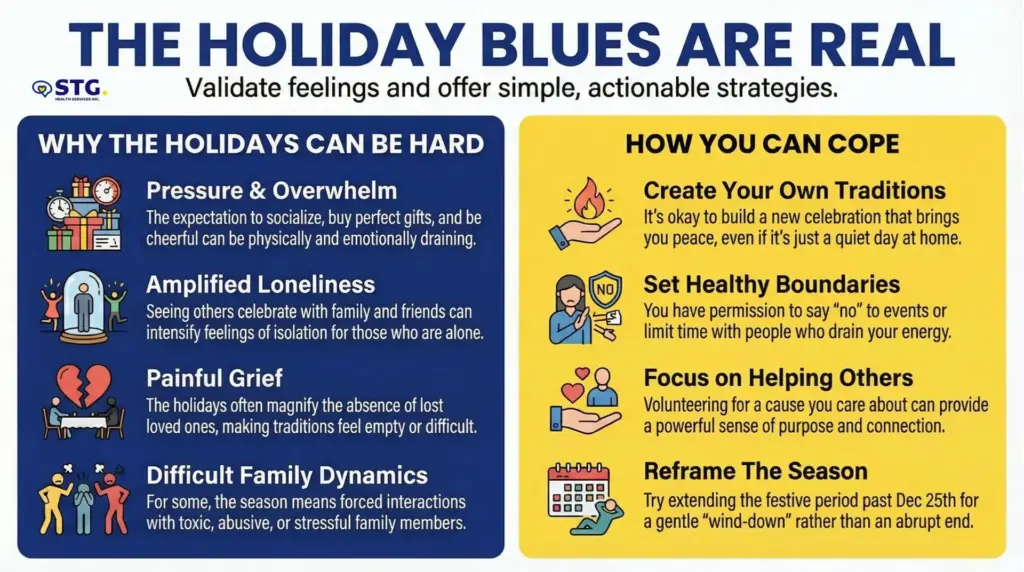
One of the biggest sources of holiday distress is what we might call “mandated cheerfulness.” Society and media create overwhelming pressure to feel and perform happiness. For anyone struggling internally, this mandate forces intense emotional labor: putting on a happy face, suppressing authentic emotions, and enduring gatherings where everyone pretends not to feel the tension in the room.
The core issue isn’t that you’re failing at the holidays—it’s that the expectation itself is impossible. Many people describe feeling like a “guilty piece of shit for hating the one time of the year that your wife and kids spend the whole year looking forward to.” The gap between external expectations of joy and internal reality amplifies feelings of inadequacy and isolation.
“Like, all this build up surrounds us and then when the clock hits 12:00 on December 26 it goes away. But with family and friends it just doesn’t end right away, there’s emotional and spiritual attachment.”
The constant performance is draining. For some people, the dominant feeling isn’t sadness at all—it’s anger at being forced into a role they never auditioned for.
2. Your Brain Is Wired to Prefer Anticipation Over Arrival
Have you ever noticed that the build-up to Christmas feels more magical than the day itself? There’s a neurochemical explanation for this pattern. Research on reward anticipation suggests that expecting a pleasurable event often produces a more significant dopamine response than the event itself. We are, in many ways, wired to find more pleasure in the chase than in the capture.
This is why Christmas Day can feel anticlimactic. The peak of excitement has often already passed. Many people recognize that “the day before your day off is better than the actual day off.” For some, the high point is December 23rd, because Christmas Eve and Day carry the bittersweet awareness that the season is ending.
“Anticipation of holidays and celebrating the holidays produces a lot of dopamine and feel good hormones, similar to when you are chasing 1st place for a race or a position. Often the chase is more enjoyable than the win. After the holidays/the event, your dopamine goes back down to regular levels or sometimes lower depending on how high it spiked.”
The return to baseline after an anticipation high can feel like a genuine crash—not because something is wrong with you, but because that’s how reward systems work.
3. Family Gatherings Can Be Genuinely Harmful, Not Just “Stressful”
For many people, family obligations are the single greatest source of holiday distress. While cultural narratives center on heartwarming reunions, the reality can range from profoundly exhausting to genuinely traumatic. For some, it’s a logistical nightmare born of guilt-tripped obligations—being forced by divorced parents to travel across three states for five gatherings in 36 hours. For others, it means reactivating past trauma or navigating difficult and manipulative personalities.
Your feelings are valid if you end the day feeling emotionally battered. You may be enduring invalidating comments, managing passive aggression, or simply being in the presence of people who have historically caused you pain. Being told to “just ignore it” when you’re being hurt isn’t a solution—it’s a dismissal of your experience.
“I would tell them to stop, but then my mother would tell me to stop and said to just ignore them while they say these comments to me… If I get so fed up that I snap and tell them to knock it off, I’m the one who gets yelled at.”
Admitting that family time is hard isn’t betrayal. It’s an honest acknowledgment of your emotional reality.
4. The Abrupt Disappearance of the Season Creates Real Loss
The holiday season creates a unique sensory and cultural environment: lights, music, decorations in every store, and a shared social focus. Then, almost overnight, it vanishes. After weeks of build-up, your house suddenly feels “naked” without its decorations. The shift from December 25th to December 26th can be genuinely jarring.
The Christmas music that filled the airwaves disappears. Store aisles are stripped with shocking speed—some retailers already have Valentine’s Day items up by mid-December. One person in Australia walked into a department store on Christmas Eve to find “every single trace of Christmas had already been wiped from the store” and replaced with back-to-school supplies.
“Especially depressing this year was turning on my car radio the day after Christmas, just to find our local ‘Santa FM’ (Christmas station) had reverted back to mainstream pop music… already.”
This abrupt removal of a shared cultural environment creates genuine loss. The emptiness you feel isn’t imaginary—it’s a response to something real that was there and is now suddenly gone.
5. Grief Gets Louder During the Holidays, Not Quieter
The holidays are potent triggers for grief. The emphasis on togetherness and tradition serves as a painful reminder of who is no longer there. The empty chair at the table isn’t just a metaphor—for many, it’s a visceral annual heartbreak. Traditions can feel hollow or broken after losing a loved one, and the season becomes a painful anniversary, forever changed.
For those who are grieving, the expectation to be festive feels like an impossible burden. Going through the motions for others’ sake is incredibly draining and can feel like a betrayal of your own sorrow. The season doesn’t pause grief; it magnifies the pain of absence.
“With all the Christmas stuff going on, I kind of want to book a month-long vacation to a country full of anti-theists. My grandfather was hard enough, but with my cousin, my nana, and my uncle dying this year, and a second one knocking on death’s door, I don’t even want to look at anything festive.”
If you’re grieving, your difficulty with this season isn’t weakness—it’s love expressing itself as pain.
6. Radical Acceptance May Be the Most Powerful Response
When faced with the overwhelming pressure of the holiday season, one of the most powerful responses is also the most counter-intuitive: give yourself permission to not be okay. This is the core of radical acceptance—acknowledging your distress, sadness, or anxiety without judgment or guilt.
This doesn’t mean giving up. It means practicing profound self-care. That might look like opting out of a stressful family event, creating entirely new traditions to reclaim the season, or simply allowing yourself a sad day without feeling you need to fix it.
Some practical approaches people have found helpful: baking a “Twelfth Night cake” to create a formal bookend to festivities, inventing new celebrations like “Januarymus” to have something to look forward to, creating monthly “mini Christmas” moments on the 25th of each month, or making a vision board for the year ahead.
“I woke up feeling so low and depressed… So I lay in bed and I cried. I just let myself feel sad and upset. And oddly, I felt better. Just acknowledging that I felt sad was actually helpful. So today, instead of forcing myself to feel joyful and happy, I’m just going to try and be at as much peace as I can.”
Accepting your feelings, rather than fighting them, is often the first step toward finding genuine peace.
When Holiday Blues May Need Professional Support
It’s important to distinguish between situational holiday distress and something that may need clinical attention. Seasonal Affective Disorder (SAD) is a recognized condition involving depression that follows seasonal patterns, typically worsening in fall and winter months due to reduced sunlight. Unlike situational holiday blues, SAD persists beyond the holiday period and may require treatment including light therapy, psychotherapy, or medication.
Consider reaching out to a mental health professional if you experience: persistent depressed mood lasting more than two weeks, significant changes in sleep or appetite, withdrawal from activities you normally enjoy, difficulty functioning at work or in relationships, feelings of hopelessness or worthlessness, or any thoughts of self-harm.
Crisis Resources: If you’re in crisis or experiencing thoughts of suicide, please reach out:
- 988 Suicide & Crisis Lifeline: Call or text 988
Finding Your Way Through
If the “most wonderful time of the year” often feels like the hardest, you are not broken or strange. The pressure, the memories, the losses, the sheer exhaustion—these are real, and feeling overwhelmed by them is a widely shared human experience.
The path forward isn’t about forcing yourself to feel a joy that isn’t there. It’s about offering yourself the same compassion you would offer anyone else who was struggling. It’s about releasing expectations that don’t serve you and honoring what you truly need—even if that looks nothing like the cultural script.
What is one expectation you could release to make the next holiday season a little kinder to yourself?
Frequently Asked Questions
Is it normal to feel sad after Christmas? Yes. Post-holiday sadness is extremely common and results from a combination of factors: the sudden end of anticipation and celebration, return to routine, unmet expectations, financial stress, and for many, grief or difficult family dynamics that the season intensifies.
Why does Christmas make my anxiety worse? Holiday anxiety often stems from multiple pressures converging: social obligations, financial strain, family tensions, perfectionism about creating the “right” experience, and the exhausting emotional labor of performing happiness. These stressors compound during a condensed period.
How long do the holiday blues last? For most people, situational holiday blues resolve within a few days to two weeks as routines normalize. If low mood, hopelessness, or difficulty functioning persist beyond two weeks, this may indicate depression that would benefit from professional support.
What’s the difference between holiday blues and Seasonal Affective Disorder? Holiday blues are situational—triggered by specific holiday stressors and typically resolving as the season passes. Seasonal Affective Disorder is a clinical condition involving recurring depression during fall and winter months, related to reduced sunlight exposure, that persists throughout the season and may require treatment.
How can I cope with grief during the holidays? There’s no single right way to grieve during the holidays. Some find comfort in maintaining traditions; others need to create new ones or skip observances entirely. Give yourself permission to feel whatever arises, set boundaries around obligations that feel harmful, and consider reaching out to a grief counselor or support group.